
Gorilla Trekking Trips – African Fly-in Safaris Ltd
Gorilla Trekking Trips is the service we offer and we do it best. African Fly-in Safaris Ltd manages and operates the Gorilla Trips website. African Fly-in Safaris Ltd is a Ugandan-based Tours and Safari Company established to deliver an enriching African holiday experience to our guests. We care about preserving the environment and natural resources, respect local customs and practices, care about the needs of the local people, and are dedicated to giving our guests more than the average package deal.
Considering our passion for the wild and the expertise we have aquired over the years wildlife guiding and gorilla trekking in the famous jungles of Uganda and Rwanda, our travel products are unquestionably top market. With over 15 years of safari experience, Gorilla Trips’ guides will take you through the thick jungles of 3 of the only habitats of the last 700 remaining mountain gorillas in the world. It’s a life’s dream adventure.
Tell us about your plans and one of our specialists will be in touch to plan a unique trip for you…
Mountain Gorilla Tracking
The endangered Mountain Gorillas of Uganda won’t be found in any zoo in the world (they do not survive in captivity and there are no surviving mountain gorillas in zoos), you can only find them and see them in Africa, in the countries of Uganda, Rwanda, and the Democratic Republic of Congo.
At Gorilla Trips African Fly-in Safaris Ltd we provide tailor-made gorilla trekking adventures to the thick jungles of Bwindi Impenetrable Forest, Nyungwe Forest, and Parc des Volcans, the last places you’ll find the last of the Mountain Gorilla families in the world.
center
#771201
default
about Uganda
ABOUT UGANDA
Gorilla Trips & The Pearl of Africa

Uganda is a tropical country and much of it lies on the African plateau between 900-1,500 meters above sea level. This gives Uganda a nice tropical climate, with temperatures averaging between 21 and 27 degrees Celsius during the day and between 12 and 18 degrees Celsius at night. Dubbed the pearl of Africa, Uganda is home to natural beauty displayed in the vast beautiful landscape and rare animal species like the Mountain Gorillas and the White Rhinos.
Click Here for Gorilla Trips to Show You More >>
left
About Rwanda
ABOUT RWANDA
Gorilla Trips & The Land of a Thousand Hills

Rwanda is a landlocked country located in east-central Africa. The country is mostly covered by steep hills and deep valleys with its highest point being Karisimbi (14,187 ft; 4,324 m) in the Virunga mountains. Although well known for the horrible history of the genocide, Rwanda is a nice country, with magnificent people, amazing lakes, mountains, a great climate, good roads, a nice standard of living with cheap things ranging from food to accommodation, and lots of other things.
Let Gorilla Trips Show You More >>
left
What You Need To Know About Gorillas
Few animals have sparked the imagination of man as much as the gorilla, the largest of the living primates and the last member of the ape family known to science. Most gorillas live in inaccessible regions in various dense forests in tropical Africa, and only in the last 30 years have scientists learned details of their life in the wild.
The powerful mountain gorilla is one of four surviving gorilla subspecies. They’re found in just two isolated populations – in the Bwindi Impenetrable National Park in Uganda, and the Virunga volcanoes – which span the borders of Rwanda, Uganda, and the Democratic Republic of the Congo (DRC).
Mountain gorillas generally live in groups with several females and their young, and one dominant male. Dominant males are known as ‘silverbacks’ because they have a patch of silver hair on their back and hips – which they develop when they’re about 12-15 years old. They’re found in high-altitude montane and bamboo forests – sometimes at elevations of 4,000m – where they mainly eat leaves, shoots, and stems.
Common Questions About Gorillas
How big do gorillas get?
Adult male gorillas weigh up to 440 pounds and can reach a height of six feet when standing on two legs. Mature male gorillas are known as “silverbacks” for the white hair that develops on their back at about 14 years of age.
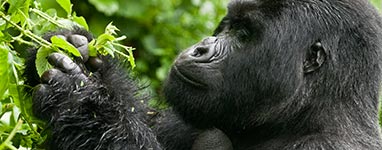
Physical Characteristics: The gorilla is massive, with a short, thick trunk and broad chest and shoulders. Its eyes and ears are dwarfed by its large head and a hairless, shiny black muzzle. Older males develop a crown of muscle and hair that makes the head look even longer. The arms are longer than the stubby legs. The fully adult male mountain gorilla is twice as large as the female.
How closely related to humans are gorillas?
Charismatic and intelligent animals, gorillas share 98.3 percent of their DNA with humans. They are our closest cousins after chimpanzees and bonobos.
25px 20px
left
#fff
Where are gorillas found?
Mountain gorillas are found in two separate locations: the Virunga range of extinct volcanic mountains on the borders of the Democratic Republic of Congo (DRC), Rwanda, and Uganda, and in the Bwindi Impenetrable National Park in Uganda. Some primatologists believe the Bwindi gorillas may be a separate subspecies.
Thanks to conservation efforts, the population of mountain gorillas have increased from 620 individuals in 1989 to around 880 individuals today. This number is likely to be accurate, as these animals have been intensely monitored since the 1950s.
[wpex more=”Read more” less=”Read less”]
The Virunga population numbers 480, and lives at altitudes ranging from 2,300-to 4,500 m. Most of these gorillas range within the southern part of Virunga National Park, DRC, and the Volcanoes National Park (Parc National des Volcans), northern Rwanda, while a few use the Mgahinga National Park, southwestern Uganda.
The Bwindi population lives at elevations of 1,500- 2,300 m. A 2011census recorded 400 individuals. Additionally, four orphaned mountain gorillas currently reside in a sanctuary in Uganda.
How often do gorillas give birth?
Females have a gestation period of 8.5 months and nurture their young for several years. Generally, females give birth to one baby every four to six years. This slow population growth makes it harder for gorillas to recover from any population decline.
Newborn gorillas weigh about 1.8 kg (4 lb.) at birth. They are as weak and uncoordinated as human babies. For the first four years of their lives, they get around by clinging to their mother’s backs. By 3.5 years of age, the young gorillas are fully weaned from their mother’s milk and start the same diet as mature mountain gorillas: plants, leaves, roots, and shoots.
[/wpex]
10px 20px
MOST PREFERRED UGANDA ADVENTURES
TRAVEL GUIDE

GORILLA TRIPS TRAVEL GUIDE
WILDLIFE ADVENTURES

UGANDA BIRDING
Best Rwanda Safaris
BEST RWANDA SAFARIS AND GORILLA TRIPS
20px 0 10px
TRAVEL GUIDE

RWANDA GORILLA TRACKING TOURS
UGANDA & RWANDA
