
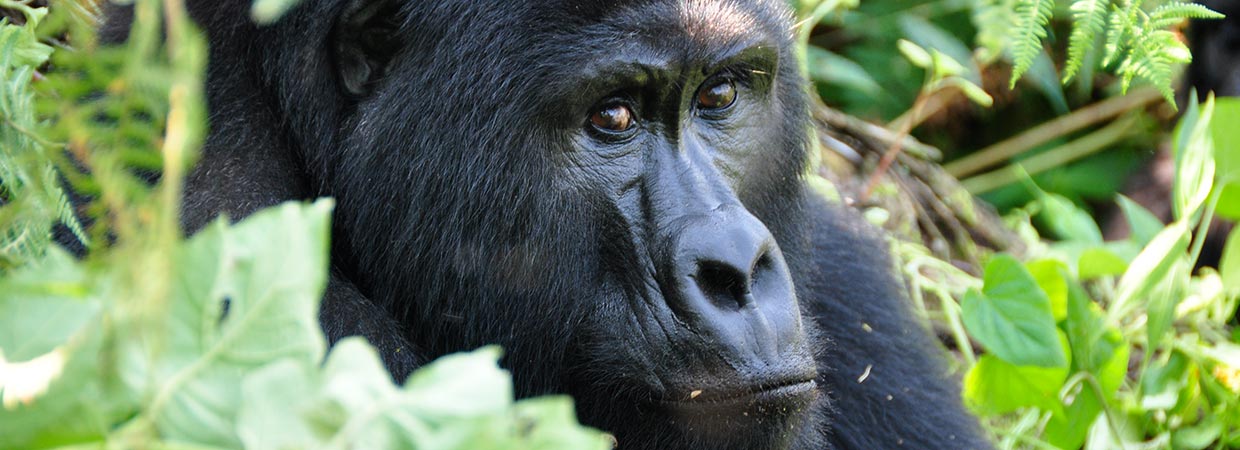




Saso Gorilla Trekking Trips, Uganda & Rwanda Safaris
Gorilla Trekking Trips is the service we offer and we do it best. Saso Uganda Safaris manages and operates Saso Gorilla Trips website. Saso Uganda Safaris is a Ugandan based Tours and Safari Company established to deliver an enriching African holiday experience to our guests. We care about preserving the environment and natural resources, respect local customs and practices, care about the needs of the local people and are dedicated to giving our guests more than the average package deal.
Considering our passion for the wild and the expertise we have aquired over the years wildlife guiding and gorilla trekking in the famous jungles of Uganda and Rwanda, our travel products are unquestionably top market. With over 15 years of safari experience, Gorilla Trips' guides will take you through the thick jungles of 3 of the only habitats of the last 700 remaining mountain gorillas in the world. It's a life's dream adventure.
Tell us about your plans and one of our specialists will be in touch to plan a unique trip for you...
Mountain Gorilla Tracking
The endangered Mountain Gorillas of Uganda won’t be found in any zoo in the world (they do not survive in captivity and there are no surviving mountain gorillas in zoos), you can only find them and see them in Africa, in the countries of Uganda, Rwanda, and the Democratic Republic of Congo.
At 'Saso' Gorilla Trekking Trips Uganda we provide tailor-made gorilla trekking adventures to the thick jumgles of Bwindi Impenetrable Forest, Nyungwe Forest and Parc des Volcans, the last places you'll find the last of the Mountain Gorilla families in the world.
Read More >
MOST PREFERRED UGANDA ADVENTURES


ABOUT UGANDA
Gorilla Trips & The Pearl of Africa

Uganda is a tropical country and much of it lies on the African plateau between 900-1,500 meters above sea level. This gives Uganda a nice tropical climate, with temperatures averaging between 21 and 27 degrees Celsius during the day and between 12 and 18 degrees Celsius at night. Dubbed the pearl of Africa, Uganda is home of natural beauty displayed in the vast beautiful landscape and rare animal species like the Mountain Gorillas and the White Rhinos.
ABOUT RWANDA
Gorilla Trips & The Land of a Thousand Hills

Rwanda is a landlocked country located in east-central Africa. The country is mostly covered by steep hills and deep valleys with its highest point being Karisimbi (14,187 ft; 4,324 m) in the Virunga mountains. Although well known for the horrible history of the genocide, Rwanda is a nice country, with magnificent people, amazing lakes, mountains, a great climate, good roads, a nice standard of living with cheap things ranging from food to accommodation and lots ofother things.
BEST RWANDA SAFARIS AND GORILLA TRIPS


What You Need To Know About Gorillas
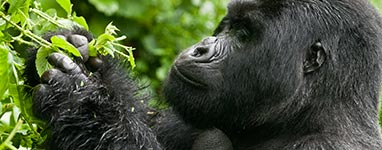
Few animals have sparked the imagination of man as much as the gorilla, the largest of the living primates and the last member of the ape family known to science. Most gorillas live in inaccessible regions in various dense forests in tropical Africa, and only in the last 30 years have scientists learned details of their life in the wild.
The powerful mountain gorilla is one of four surviving gorilla subspecies. They’re found in just two isolated populations – in the Bwindi Impenetrable National Park in Uganda, and the Virunga volcanoes – which span the borders of Rwanda, Uganda and the Democratic Republic of the Congo (DRC).
Mountain gorillas generally live in groups with several females and their young, and one dominant male. Dominant males are known as ‘silverbacks’ because they have a patch of silver hair on their back and hips – which they develop when they’re about 12-15 years old. They’re found in high-altitude montane and bamboo forests – sometimes at elevations of 4,000m – where they mainly eat leaves, shoots and stems.
Common Questions About Gorillas
How big do gorillas get?
Adult male gorillas weigh up to 440 pounds and can reach a height of six feet when standing on two legs. Mature male gorillas are known as “silverbacks” for the white hair that develops on their back at about 14 years of age.
Physical Characteristics: The gorilla is massive, with a short, thick trunk and broad chest and shoulders. Its eyes and ears are dwarfed by its large head and hairless, shiny black muzzle. Older males develop a crown of muscle and hair that makes the head look even longer. The arms are longer than the stubby legs. The fully adult male mountain gorilla is twice as large as the female.
How closely related to humans are gorillas?
Charismatic and intelligent animals, gorillas share 98.3 percent of their DNA with humans. They are our closest cousins after chimpanzees and bonobos.
Where are gorillas found?
Mountain gorillas are found in two separate locations: the Virunga range of extinct volcanic mountains on the borders of the Democratic Republic of Congo (DRC), Rwanda and Uganda, and in the Bwindi Impenetrable National Park in Uganda. Some primatologists believe the Bwindi gorillas may be a separate subspecies.
Thanks to conservation efforts, the population of mountain gorillas has increased from 620 individuals in 1989 to around 880 individuals today. This number is likely to be accurate, as these animals have been intensely monitored since the 1950s.
The Virunga population numbers 480, and lives at altitudes ranging from 2,300-4,500 m. Most of these gorillas range within the southern part of Virunga National Park, DRC, and the Volcanoes National Park (Parc National des Volcans), northern Rwanda, while a few use the Mgahinga National Park, southwestern Uganda.
The Bwindi population lives at elevations of 1,500- 2,300 m. A 2011census recorded 400 individuals. Additionally, four orphaned mountain gorillas currently reside in a sanctuary in Uganda.
How often do gorilla give birth?
Females have a gestation period of 8.5 months and nurture their young for several years. Generally, females give birth to one baby every four to six years. This slow population growth makes it harder for gorillas to recover from any population decline.
Newborn gorillas weigh about 1.8 kg (4 lb.) at birth. They are as weak and uncoordinated as human babies. For the first four years of their lives, they get around by clinging to their mothers backs. By 3.5 years of age, the young gorillas are fully weaned from their mothers milk and start the same diet as mature mountain gorillas: plants, leaves, roots and shoots.
[/wpex]